

FreightWaves Warns of Diesel Market Uncertainty. FuelProphet Helped Buyers Navigate It.

A recent FreightWaves article highlighted a sharp decline in diesel prices while industry analysts simultaneously warned about the possibility of tightening diesel inventories and emerging "tank bottom" conditions. In other words, the market is sending mixed signals.

For wholesale fuel buyers, this creates a familiar challenge:

Should you buy today or wait until tomorrow?

The answer isn't always obvious.

Many buyers watch crude oil, diesel futures, or industry headlines. But wholesale rack prices often move differently than expected. Regional supply conditions, replacement costs, transportation constraints, and local market dynamics can all influence what suppliers charge.

That's why FuelProphet focuses on one thing: helping buyers make better purchasing decisions before rack prices change.

What Happened Last Week?

During the week of June 2–5, FuelProphet's reports identified major directional shifts in the diesel market.

On June 3, FuelProphet projected diesel rack increases of approximately 13 cents per gallon and advised customers to lift product before higher prices became effective.

Just one day later, the model detected a significant reversal.

On June 4, FuelProphet projected diesel rack declines ranging from 13 to 23 cents per gallon across key regions and advised customers to wait before purchasing.

The following day, FuelProphet continued to signal lower diesel pricing and again recommended waiting.

At the same time, FreightWaves reported that benchmark diesel prices had fallen sharply to their lowest levels in months, while analysts debated whether future supply concerns could eventually reverse the trend.

Headlines Don't Tell You What To Do Tomorrow

The FreightWaves article illustrates a common problem for fuel buyers.

You can read an article that warns of tighter supplies.

You can hear analysts discussing future shortages.

You can see crude oil moving higher.

Yet wholesale rack prices may still move lower tomorrow.

That's why FuelProphet exists.

Our subscribers don't receive hundreds of charts or pages of market commentary.

They receive a simple recommendation:

  • Lift

  • Wait

  • Neutral

Combined with projected rack price movement for the next pricing cycle.

What Could This Mean Financially?

For an 8,500-gallon transport load, every 10-cent-per-gallon move represents approximately $850 in cost difference.

When diesel markets swing 15 to 20 cents in just a day or two, timing matters.

A single well-timed purchasing decision can generate savings that exceed the cost of a FuelProphet subscription many times over.

The Bottom Line

The diesel market remains volatile.

As FreightWaves noted, today's declining prices can coexist with tomorrow's supply concerns.

The challenge isn't understanding what happened yesterday.

The challenge is deciding what to do next.

FuelProphet has helped wholesale fuel buyers navigate these market swings for more than 20 years by providing actionable rack-price guidance designed specifically for buyers making real purchasing decisions.

Want to know where wholesale fuel prices may move next?

Start your free 14-day FuelProphet trial today and receive twice-daily rack price guidance delivered directly to your inbox.


Number used for most fuel surcharges is down to its lowest level since mid-March, soon after start of Iran hostilities

John Kingston

·Tuesday, June 02, 2026

The benchmark diesel price is at its lowest level since March. (Photo: Jim Allen\FreightWaves)

The benchmark diesel price used for most fuel surcharges is now down to a level not seen since a few weeks after the military confrontation between Israel and the U.S./Israel coalition began.

The Department of Energy/Energy Information Administration average retail diesel price fell 17.3 cents/gallon to $5.35/g. It’s the lowest price since March 23, when prices were surging following the start of hostilities between the two sides. On that date, the DOE/EIA price was $5.375/g.

The price was $3.897/g on March 2, in the last number published just as the war was beginning two days before that date.

Second-biggest drop

In this highly volatile market, the 17.3 cts/g decline this week was only the second biggest weekly fall.  Only on April 20, soon after the ceasefire was announced, did the benchmark record a larger decline than this week, sliding 20.5 cts/g. 

The volatile market can be seen in some of the regional diesel prices published Tuesday, effective Monday, for various parts of the region. While the U.S average was down 17.3 cts/g, it was only down 6.8 cts in New England and 7.7 cts/g in the West Coast excluding California. Meanwhile, the price fell 23.1 cts/g in the Midwest, which had been affected by refinery issues that are now largely fixed. 

That volatility could be a reason why the DOE/EIA price and the average daily price of the AAA were so different for Monday, the effective day of the DOE benchmark. The AAA price for Monday was $5.448/g, almost a full 10 cents more than the DOE/EIA price. 

The drop in the benchmark comes against a background of a decline in the price of ultra low sulfur diesel (ULSD) on the CME commodity exchange as talk of some sort of peace deal and a reopening of the Strait of Hormuz have been the key focus of traders. 

From a settlement of $4.1625/g on May 19, ULSD fell to a settlement Friday of $3.4886/g, a decline of more than 67 cts/g.

Recent reversal

But as has happened so many times in this up and down market that waits on every development regarding a reopening of the strait, the trend in commodity markets the last two days has been solidly upward.

ULSD for July delivery–that month is now the front month contract on the CME–rose more than 15 cts/g between Friday and Monday after a weekend of news reports that suggested peace and a reopening of the international waterway was becoming less likely, not more.

In trading Tuesday, prices pushed up again, though at a slower rate. At approximately 10:40 a.m. EDT, ULSD was up 2.23 cts/g to $3.6617/g.

Execs seeing a tipping point

The overall downward trend in prices is occurring even as two leading oil market executives last week, at the Sanford Bernstein 42nd Annual Strategic Decisions Conference in New York, put forth a scenario for the coming weeks that was anything but bearish.

There have been analyst discussions recently of a term known as “tank bottoms.” It’s essentially the minimum level of inventories needed for the oil system to operate. It doesn’t mean inventories go to zero, but they are down at a level where to pull on them further could cause operational issues.

Chevron CEO Mike Wirth was interviewed by Bob Brackett of Sanford Bernstein. Wirth didn’t use the term “tank bottoms,” but Brackett did. 

Wirth noted that global inventories at the start of the war were at extremely high levels. Those stocks served as a buffer from the lost supply out of the Strait of Hormuz, which he estimated at about 12 million to 13 million b/d out of a global oil market of just over 100 million b/d. 

“You’ve got all this inventory that sits in between the ins and the outs, and that has been able to buffer the pressure,” Wirth said. 

But then he warned: “The buffers and the shock absorbers are being steadily drawn down and the ability for the market to absorb this imbalance is drastically diminished today versus where we started.”

Neil Chapman, a senior vice president at ExxonMobil, echoed a similar sentiment. 

“We’re approaching unheard of inventory levels,” Chapman said, also in a fireside discussion with Brackett. “I mean, really, really low levels. You can debate whether that’s going to hit those really low levels in 2 weeks or 3 weeks. But once you get to that point, then you’ll see prices shoot up.”

More articles by John Kingston

Texas court nixes shipper liability in Home Depot/Werner case

Carrier Nussbaum sets driver pay increase; others popping up more quietly
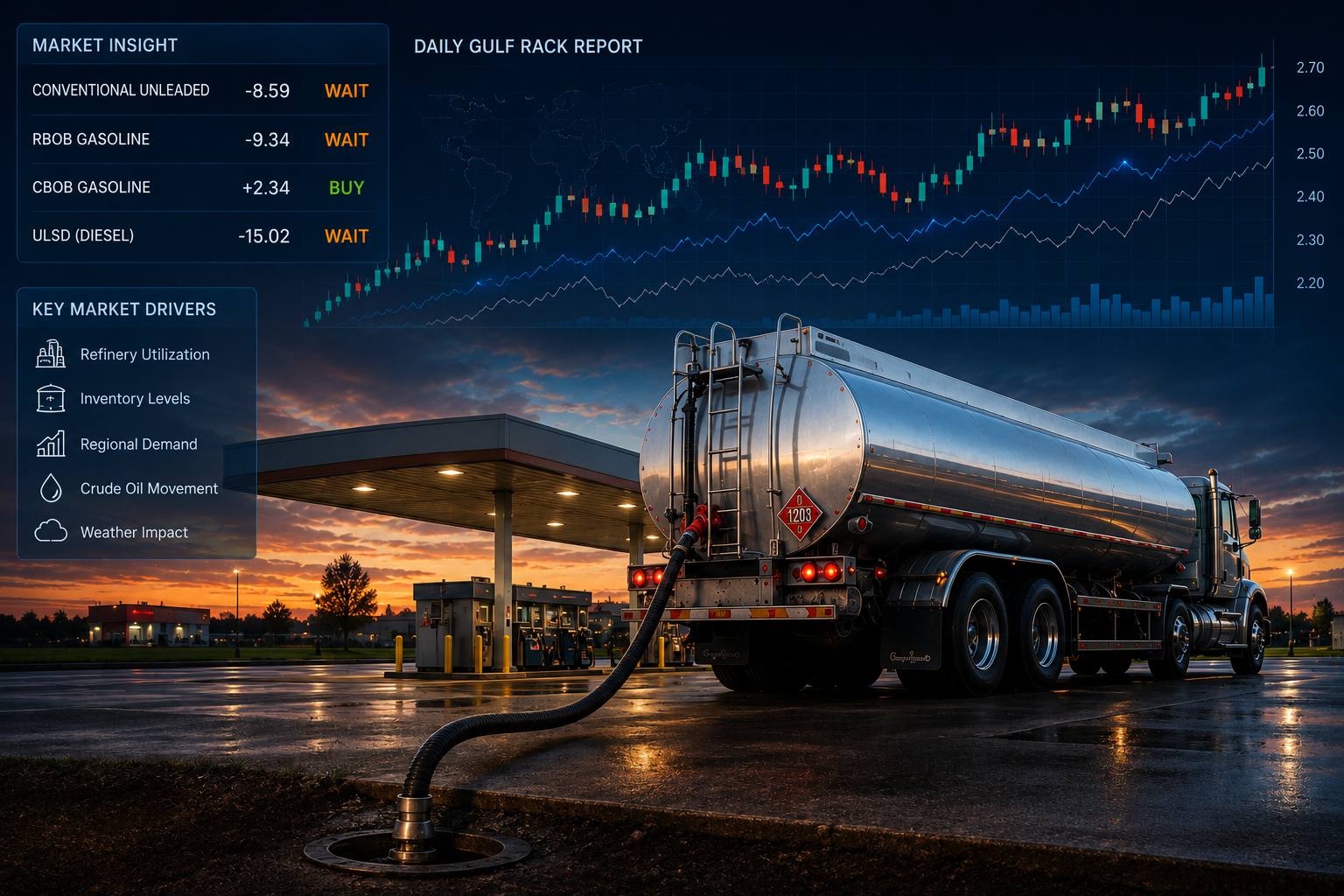
Today's 15¢ Market Drop Could Have Saved Fuel Buyers $1,275 on a Single Load

Today's crude market moved approximately 15 cents lower, reminding fuel buyers of one important reality:

Timing matters.

For many independent fuel retailers and convenience store operators, wholesale fuel purchases are measured in truckloads—not gallons. A typical transport load of 8,500 gallons can turn even a modest market movement into a significant financial event.

The Math is Simple

  • Market Move: -15¢ per gallon

  • Truckload Size: 8,500 gallons

  • Potential Savings by Waiting One Day:

$1,275

If you purchased yesterday and the market fell today, that truckload cost you an additional $1,275.

If you knew the market was likely to soften and waited, those dollars stay in your business instead.

The Challenge

Many fuel buyers naturally watch crude oil prices, but crude is only one piece of the equation.

Wholesale rack pricing is influenced by:

  • Regional supply and demand

  • Spot market replacement costs

  • Refinery outages and maintenance

  • Pipeline disruptions

  • Local market dynamics

  • Trader sentiment and positioning

As many experienced buyers know, crude can move down while rack prices move up—or vice versa.

Why FuelProphet Exists

FuelProphet was built to simplify these complex market signals into practical daily buying guidance.

Twice each day, subscribers receive straightforward recommendations that help answer one simple question:

Should I buy fuel today, or should I wait?

Rather than overwhelming users with charts and market jargon, FuelProphet translates upstream market intelligence into actionable guidance for wholesale fuel buyers.

Small Decisions. Big Annual Impact.

A single $1,275 savings opportunity is meaningful.

Multiply that across multiple loads each month, and the value of informed purchasing decisions becomes even more significant.

No forecasting tool can eliminate market uncertainty, but having better intelligence can help buyers make more confident decisions when volatility strikes.

What Will the Market Do Tomorrow?

The next meaningful move could happen overnight.

AI Can Predict Patterns. Experience Predicts Markets.

Artificial intelligence is changing nearly every industry, and wholesale fuel buying is no exception. Today, sophisticated algorithms can process enormous amounts of historical pricing data, identify trends, and forecast future market movements.

But there is one important question every fuel buyer should ask:

Is historical data alone enough to predict tomorrow's rack price?

At FuelProphet, we don't believe it is.

Wholesale Fuel Markets Aren't Linear

Many people assume that if crude oil rises, rack prices will rise the next day. In reality, experienced fuel buyers know it rarely works that way.

Rack prices are influenced by a complex combination of factors, including:

  • Spot market replacement costs

  • Regional supply and demand imbalances

  • Refinery outages and maintenance

  • Pipeline disruptions

  • Terminal inventory positions

  • Seasonal blending requirements

  • Transportation bottlenecks

  • Futures market sentiment

A 2% increase in crude oil may have very little impact on tomorrow's wholesale rack posting—or it could be completely overshadowed by a regional supply event.

That's why simply watching crude prices often leads buyers in the wrong direction.

The Limits of AI-Only Forecasting

Artificial intelligence excels at finding patterns in historical data. Given enough information, machine learning models can identify relationships that humans might miss.

However, AI models generally answer one question:

"What happened before under similar conditions?"

Fuel markets frequently create situations where there is no perfect historical comparison.

A refinery fire, an unexpected pipeline shutdown, geopolitical tensions, or sudden shifts in local demand can quickly change the market dynamic.

The challenge isn't simply recognizing a pattern.

The challenge is understanding whether today's market conditions actually matter tomorrow.

The FuelProphet Difference: Human Expertise + Analytics

FuelProphet was built on the idea that the best forecasting combines the speed of data analysis with the judgment of experienced fuel traders.

Our process blends:

Quantitative Market Signals

We continuously monitor upstream market indicators that influence wholesale fuel pricing.

Wholesale Rack Economics

We focus on the factors that directly affect rack replacement costs—not simply headline crude oil movements.

Experienced Market Interpretation

Our energy professionals evaluate how current events and market conditions are likely to influence actual purchasing decisions.

The result isn't another complicated dashboard full of charts.

It's a simple recommendation designed to answer the question every wholesale fuel buyer faces:

Should I lift product today, wait until tomorrow, or hold neutral?

Simplicity Creates Value

Most independent fuel distributors, convenience store operators, and commercial fuel buyers don't have an in-house trading desk.

They don't have time every morning to analyze futures markets, monitor refinery news, or calculate basis differentials.

They simply need to make the best possible buying decision.

FuelProphet transforms complex market intelligence into clear, actionable guidance that helps buyers make more informed purchasing decisions.

The Future Isn't AI or Human Expertise.

It's Both.

Artificial intelligence is an incredibly powerful tool.

Human experience remains incredibly valuable.

The companies that will make the best fuel buying decisions won't rely exclusively on one or the other—they'll combine both.

At FuelProphet, that's exactly what we've been doing.

Because in wholesale fuel markets, knowing what happened yesterday is useful.

Knowing what is likely to happen tomorrow is invaluable.

Wondering what the market will do tomorrow?

Sign up to receive your free report today!

Oil Prices Spike as U.S. and Iran Exchange Fire - Will Wholesale Fuel Prices Surge?

Last night's attacks involving Iran are another reminder of how quickly geopolitical events can impact energy markets.

As news broke, crude oil futures surged higher, and many fuel buyers immediately assumed wholesale rack prices would follow.

But here's the reality:

Just because crude oil moves up doesn't necessarily mean rack prices will move up tomorrow.

In today's market, wholesale fuel prices are influenced by far more than crude oil alone. Refinery operations, regional supply and demand, inventory levels, transportation constraints, futures market structure, and local rack economics all play a role in determining tomorrow's rack price.

That's why some of the most costly fuel buying decisions happen when buyers react solely to headlines.

The question isn't:

"What did crude oil do today?"

The question is:

"What will my rack price do tomorrow?"

Those are often two very different answers.

At FuelProphet, we analyze the upstream market signals that impact wholesale fuel pricing and translate them into simple, actionable guidance:

⬆️ Lift Today
⬇️ Wait Until Tomorrow
➡️ Neutral

When volatility strikes, market intelligence becomes even more valuable.

Because in a rapidly changing market, knowing that crude is up isn't enough.

Knowing whether your rack price is likely to move up, down, or remain stable is what helps you make better buying decisions.


Oil Prices Spike as U.S. and Iran Exchange Fire

By The New York Times

June 1, 2026Updated 10:51 a.m. ET

Listen · 2:55 min

Global markets convulsed after a report in Iran’s semiofficial Tasnim News Agency, which is affiliated with the country’s Revolutionary Guards, that Iran would stop engaging in negotiations because of Israel’s actions in Lebanon.

The report could not immediately be confirmed and didn’t cite its sources. Still, oil prices rose sharply higher and government bond yields rose. Stocks were mixed, sliding in Europe but barely budging in the U.S.

Israel has continued its military campaign in Southern Lebanon, despite Iranian claims that the region was part of the original cease-fire struck in April. Meanwhile, Iran and the United States also continued to exchange fire.

The United States said it carried out a series of “self-defense” strikes in Iran over the weekend, the latest in a series of attacks in the past week. Iran’s Revolutionary Guard announced that it had struck a U.S. air base in retaliation for a U.S. attack on a communications facility.

Last Week Proved Again: Timing Rack Purchases Matters

For wholesale fuel buyers, last week was another reminder that rack prices can change quickly — and timing purchasing decisions correctly can create meaningful cost advantages.

Between May 19 and May 22, the market shifted dramatically across gasoline and diesel products.

On May 19, FuelProphet indicators across multiple gasoline markets projected significant downward rack movement for the following day:

  • Gulf Conventional Unleaded: -10.0¢

  • Group III Conventional Unleaded: -15.0¢

  • Chicago Conventional Unleaded: -13.0¢

  • NYH Conventional Unleaded: -10.0¢

FuelProphet’s recommendation at that time was simple: Wait.

For a typical 8,500-gallon transport load, correctly waiting to purchase fuel in one of these markets could have represented savings such as:

  • 10¢ move = approximately $850 per load

  • 15¢ move = approximately $1,275 per load

Just three days later, on May 22, the market reversed sharply.

FuelProphet indicators then projected upward movement:

  • Gulf Conventional Unleaded: +7.0¢

  • Group III Conventional Unleaded: +6.0¢

  • Chicago Conventional Unleaded: +6.0¢

  • NYH Conventional Unleaded: +1.0¢

The recommendation shifted to: Lift.

That meant buyers who delayed purchasing after this signal potentially faced paying significantly higher rack prices the next day.

Diesel markets also demonstrated how regional conditions can vary quickly:

  • Chicago ULSD projected +16.0¢ on May 19

  • Group III ULSD projected -12.0¢ the same day

This is exactly why wholesale fuel purchasing requires more than simply watching headlines or futures prices. Rack pricing reacts to regional supply conditions, pipeline activity, refinery economics, inventory positioning, transportation constraints, and local supplier behavior — often changing moment to moment.

Why FuelProphet Matters

FuelProphet was designed to simplify these movements into clear purchasing guidance.

Instead of overwhelming buyers with dashboards and market noise, FuelProphet delivers straightforward advice twice daily:

  • Lift now

  • Wait until tomorrow

  • Neutral

For fuel marketers, distributors, commercial fleets, and large-volume buyers, timing even a portion of purchases correctly can create substantial monthly savings opportunities.

And as we move into another active market week with ongoing volatility in crude, refining margins, and regional supply dynamics, having timely guidance becomes even more valuable.

Because in wholesale fuel buying, timing matters.

One load may not seem significant. Over dozens or hundreds of loads, the impact adds up quickly.

Learn more about FuelProphet at FuelProphet.com.

Why Timing Fuel Purchases Is More Valuable Than Most Companies Realize

When wholesale fuel buyers think about reducing costs, most focus on negotiating supplier pricing, transportation costs, or operational efficiencies.

But one of the most overlooked opportunities may be much simpler:

Timing the purchase correctly.

In today’s volatile fuel market, even small daily price movements can create significant financial impact when multiplied across transport loads.

Small Market Changes Add Up Quickly

A change of just 3 cents per gallon may not sound substantial at first glance.

However, on a standard 8,500-gallon transport load, that movement represents approximately:

$255 per load

For companies lifting:

  • One load per day

  • Multiple transports per week

  • Several terminals across regions

…the exposure to market timing can become substantial over time.

The reality is that fuel purchasing decisions are often not just about finding the lowest supplier price — they are about understanding market direction before the next rack price change occurs.

Fuel Markets Move Fast

Rack prices can shift overnight due to:

  • Crude oil volatility

  • Refinery outages

  • Seasonal demand changes

  • Inventory reports

  • Geopolitical developments

  • Futures market activity

Waiting too long to lift product can increase costs significantly.

Buying too early can create frustration when prices decline the next day.

That uncertainty is exactly why market timing matters.

Better Timing Creates Better Decisions

Many fuel buyers are overwhelmed with:

  • Complex dashboards

  • Excessive market data

  • Conflicting opinions

  • Delayed information

But most buyers are not looking to become energy traders.

They simply want practical guidance that helps answer a straightforward question:

“Should we buy today or wait until tomorrow?”

A Simpler Approach to Fuel Market Insight

FuelProphet delivers twice-daily fuel market forecasts designed specifically for wholesale fuel buyers.

Subscribers receive:

  • Clear BUY or WAIT recommendations

  • Daily market direction insight

  • Commentary from industry experts

  • Timely guidance before rack prices change

No complicated dashboards.

No overwhelming data.

Just actionable fuel market guidance delivered directly to your inbox.

Confidence Matters

No forecasting tool can predict every market movement perfectly.

However, improving purchasing timing consistently over time can help organizations:

  • Reduce exposure to sudden price swings

  • Improve purchasing confidence

  • Simplify daily fuel buying decisions

  • Better understand market trends

In a market where pennies per gallon matter, timing matters too.

Start Your Free 14-Day Trial

FuelProphet helps wholesale fuel buyers make better-informed timing decisions with clear, practical market insight delivered twice daily.

FuelProphet.com

Better Insight. Better Timing. Better Results.

The Most Expensive Guess in Wholesale Fuel Buying

The Most Expensive Guess in Wholesale Fuel Buying

Every day, wholesale fuel buyers make a decision that can impact margins by hundreds — or even thousands — of dollars:

Should we buy fuel today, or wait until tomorrow?

The challenge is that many companies are making that decision with incomplete information, reacting to market movement instead of anticipating it.

In today’s fuel market, timing matters.

Rack prices can shift quickly based on:

  • Crude oil movement

  • Refinery outages

  • Supply disruptions

  • Seasonal demand

  • Futures market activity

  • Geopolitical events

Even a small overnight change can have a significant financial impact when multiplied across transport loads.

For example, a market movement of just 3 cents per gallon on an 8,500-gallon transport load represents a difference of approximately $255 per load. For companies lifting multiple loads per week, the impact adds up quickly.

The Problem With Traditional Market Monitoring

Many wholesale fuel buyers rely on:

  • Historical trends

  • Supplier conversations

  • Market headlines

  • Manual spreadsheets

  • Gut instinct

Others attempt to use overly complicated analytics platforms that provide more data than actionable guidance.

But fuel buyers do not necessarily need more dashboards.

They need:

  • Clear market direction

  • Actionable insight

  • Timely recommendations

  • Confidence in purchasing decisions

A Simpler Approach to Fuel Buying Decisions

FuelProphet was built to answer one practical question:

“Should I BUY today or WAIT until tomorrow?”

FuelProphet delivers twice-daily market forecasts directly to your inbox with:

  • Simple BUY or WAIT guidance

  • Market commentary from industry experts

  • Insight into daily market direction

  • Clear, actionable recommendations

No complicated dashboards.

No overwhelming data.

Just practical fuel market guidance designed specifically for wholesale fuel buyers.

Why Timing Matters

No forecasting tool can eliminate market volatility completely.

However, improving timing decisions consistently over time can help fuel buyers:

  • Reduce exposure to sudden price swings

  • Improve purchasing confidence

  • Simplify decision-making

  • Better understand market direction

In volatile markets, having timely insight before rack prices change can create meaningful value.

Stop Guessing

Fuel purchasing decisions should not feel like gambling.

FuelProphet helps wholesale fuel buyers make more informed timing decisions with straightforward market guidance delivered twice daily.

Start Your Free 14-Day Trial Today

FuelProphet.com

Better Insight. Better Timing. Better Results.

How FuelProphet Helps Fuel Buyers Stay Ahead of Market Shifts

The wholesale fuel market is notoriously unpredictable. Prices can change rapidly based on supply chain disruptions, refinery output, international conflicts, and seasonal demand spikes. For small to mid-sized gas station owners and fleet managers, these swings can directly impact profit margins and operational costs.

That’s where FuelProphet comes in.

Real-Time Price Predictions

FuelProphet uses advanced data analysis to deliver daily wholesale price predictions for gasoline and diesel. With insights updated every morning, subscribers can anticipate cost changes before they hit the rack. This knowledge allows buyers to make smarter purchasing decisions and time their orders more effectively.

Designed for Independent Operators

Unlike large oil companies that rely on teams of analysts, independent fuel buyers often have to rely on limited information. FuelProphet levels the playing field by putting powerful forecasting tools directly in the hands of:

  • Gas station owners who purchase by the truckload

  • Fleet managers for buses, taxis, contractors, and delivery companies

Saving Time and Money

Even a few cents per gallon can add up to thousands of dollars in profit or loss over a year. By using FuelProphet, buyers can reduce risk, improve budgeting, and gain confidence in their purchasing strategies.

A Smarter Way to Buy Fuel

As the energy landscape evolves, staying informed is more important than ever. FuelProphet provides the clarity and foresight you need to navigate the volatility of wholesale fuel prices with confidence.