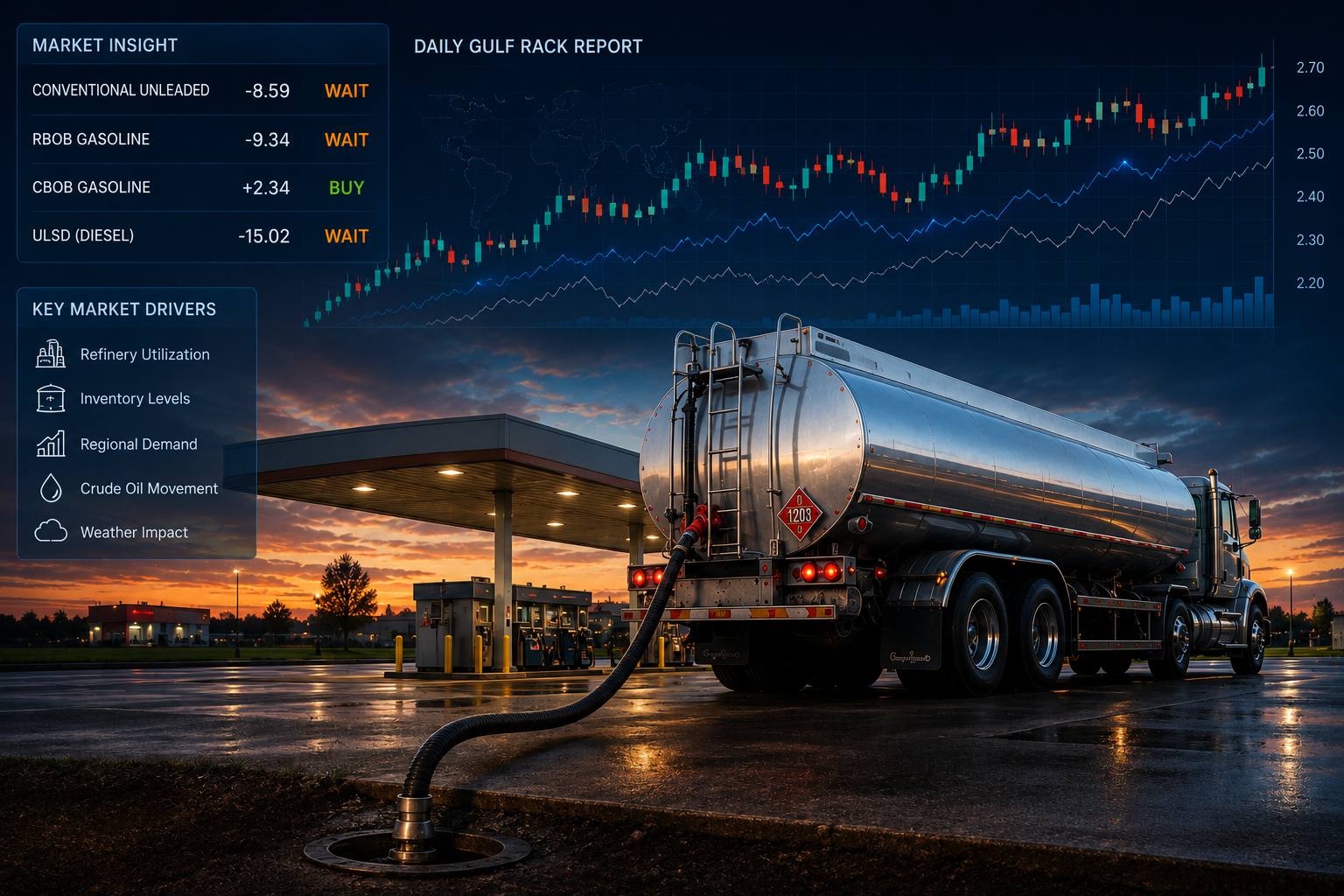
Oil Prices Spike as U.S. and Iran Exchange Fire - Will Wholesale Fuel Prices Surge?

Last night's attacks involving Iran are another reminder of how quickly geopolitical events can impact energy markets.

As news broke, crude oil futures surged higher, and many fuel buyers immediately assumed wholesale rack prices would follow.

But here's the reality:

Just because crude oil moves up doesn't necessarily mean rack prices will move up tomorrow.

In today's market, wholesale fuel prices are influenced by far more than crude oil alone. Refinery operations, regional supply and demand, inventory levels, transportation constraints, futures market structure, and local rack economics all play a role in determining tomorrow's rack price.

That's why some of the most costly fuel buying decisions happen when buyers react solely to headlines.

The question isn't:

"What did crude oil do today?"

The question is:

"What will my rack price do tomorrow?"

Those are often two very different answers.

At FuelProphet, we analyze the upstream market signals that impact wholesale fuel pricing and translate them into simple, actionable guidance:

⬆️ Lift Today
⬇️ Wait Until Tomorrow
➡️ Neutral

When volatility strikes, market intelligence becomes even more valuable.

Because in a rapidly changing market, knowing that crude is up isn't enough.

Knowing whether your rack price is likely to move up, down, or remain stable is what helps you make better buying decisions.


Oil Prices Spike as U.S. and Iran Exchange Fire

By The New York Times

June 1, 2026Updated 10:51 a.m. ET

Listen · 2:55 min

Global markets convulsed after a report in Iran’s semiofficial Tasnim News Agency, which is affiliated with the country’s Revolutionary Guards, that Iran would stop engaging in negotiations because of Israel’s actions in Lebanon.

The report could not immediately be confirmed and didn’t cite its sources. Still, oil prices rose sharply higher and government bond yields rose. Stocks were mixed, sliding in Europe but barely budging in the U.S.

Israel has continued its military campaign in Southern Lebanon, despite Iranian claims that the region was part of the original cease-fire struck in April. Meanwhile, Iran and the United States also continued to exchange fire.

The United States said it carried out a series of “self-defense” strikes in Iran over the weekend, the latest in a series of attacks in the past week. Iran’s Revolutionary Guard announced that it had struck a U.S. air base in retaliation for a U.S. attack on a communications facility.

Last Week Proved Again: Timing Rack Purchases Matters

For wholesale fuel buyers, last week was another reminder that rack prices can change quickly — and timing purchasing decisions correctly can create meaningful cost advantages.

Between May 19 and May 22, the market shifted dramatically across gasoline and diesel products.

On May 19, FuelProphet indicators across multiple gasoline markets projected significant downward rack movement for the following day:

  • Gulf Conventional Unleaded: -10.0¢

  • Group III Conventional Unleaded: -15.0¢

  • Chicago Conventional Unleaded: -13.0¢

  • NYH Conventional Unleaded: -10.0¢

FuelProphet’s recommendation at that time was simple: Wait.

For a typical 8,500-gallon transport load, correctly waiting to purchase fuel in one of these markets could have represented savings such as:

  • 10¢ move = approximately $850 per load

  • 15¢ move = approximately $1,275 per load

Just three days later, on May 22, the market reversed sharply.

FuelProphet indicators then projected upward movement:

  • Gulf Conventional Unleaded: +7.0¢

  • Group III Conventional Unleaded: +6.0¢

  • Chicago Conventional Unleaded: +6.0¢

  • NYH Conventional Unleaded: +1.0¢

The recommendation shifted to: Lift.

That meant buyers who delayed purchasing after this signal potentially faced paying significantly higher rack prices the next day.

Diesel markets also demonstrated how regional conditions can vary quickly:

  • Chicago ULSD projected +16.0¢ on May 19

  • Group III ULSD projected -12.0¢ the same day

This is exactly why wholesale fuel purchasing requires more than simply watching headlines or futures prices. Rack pricing reacts to regional supply conditions, pipeline activity, refinery economics, inventory positioning, transportation constraints, and local supplier behavior — often changing moment to moment.

Why FuelProphet Matters

FuelProphet was designed to simplify these movements into clear purchasing guidance.

Instead of overwhelming buyers with dashboards and market noise, FuelProphet delivers straightforward advice twice daily:

  • Lift now

  • Wait until tomorrow

  • Neutral

For fuel marketers, distributors, commercial fleets, and large-volume buyers, timing even a portion of purchases correctly can create substantial monthly savings opportunities.

And as we move into another active market week with ongoing volatility in crude, refining margins, and regional supply dynamics, having timely guidance becomes even more valuable.

Because in wholesale fuel buying, timing matters.

One load may not seem significant. Over dozens or hundreds of loads, the impact adds up quickly.

Learn more about FuelProphet at FuelProphet.com.

Why Timing Fuel Purchases Is More Valuable Than Most Companies Realize

When wholesale fuel buyers think about reducing costs, most focus on negotiating supplier pricing, transportation costs, or operational efficiencies.

But one of the most overlooked opportunities may be much simpler:

Timing the purchase correctly.

In today’s volatile fuel market, even small daily price movements can create significant financial impact when multiplied across transport loads.

Small Market Changes Add Up Quickly

A change of just 3 cents per gallon may not sound substantial at first glance.

However, on a standard 8,500-gallon transport load, that movement represents approximately:

$255 per load

For companies lifting:

  • One load per day

  • Multiple transports per week

  • Several terminals across regions

…the exposure to market timing can become substantial over time.

The reality is that fuel purchasing decisions are often not just about finding the lowest supplier price — they are about understanding market direction before the next rack price change occurs.

Fuel Markets Move Fast

Rack prices can shift overnight due to:

  • Crude oil volatility

  • Refinery outages

  • Seasonal demand changes

  • Inventory reports

  • Geopolitical developments

  • Futures market activity

Waiting too long to lift product can increase costs significantly.

Buying too early can create frustration when prices decline the next day.

That uncertainty is exactly why market timing matters.

Better Timing Creates Better Decisions

Many fuel buyers are overwhelmed with:

  • Complex dashboards

  • Excessive market data

  • Conflicting opinions

  • Delayed information

But most buyers are not looking to become energy traders.

They simply want practical guidance that helps answer a straightforward question:

“Should we buy today or wait until tomorrow?”

A Simpler Approach to Fuel Market Insight

FuelProphet delivers twice-daily fuel market forecasts designed specifically for wholesale fuel buyers.

Subscribers receive:

  • Clear BUY or WAIT recommendations

  • Daily market direction insight

  • Commentary from industry experts

  • Timely guidance before rack prices change

No complicated dashboards.

No overwhelming data.

Just actionable fuel market guidance delivered directly to your inbox.

Confidence Matters

No forecasting tool can predict every market movement perfectly.

However, improving purchasing timing consistently over time can help organizations:

  • Reduce exposure to sudden price swings

  • Improve purchasing confidence

  • Simplify daily fuel buying decisions

  • Better understand market trends

In a market where pennies per gallon matter, timing matters too.

Start Your Free 14-Day Trial

FuelProphet helps wholesale fuel buyers make better-informed timing decisions with clear, practical market insight delivered twice daily.

FuelProphet.com

Better Insight. Better Timing. Better Results.

The Most Expensive Guess in Wholesale Fuel Buying

The Most Expensive Guess in Wholesale Fuel Buying

Every day, wholesale fuel buyers make a decision that can impact margins by hundreds — or even thousands — of dollars:

Should we buy fuel today, or wait until tomorrow?

The challenge is that many companies are making that decision with incomplete information, reacting to market movement instead of anticipating it.

In today’s fuel market, timing matters.

Rack prices can shift quickly based on:

  • Crude oil movement

  • Refinery outages

  • Supply disruptions

  • Seasonal demand

  • Futures market activity

  • Geopolitical events

Even a small overnight change can have a significant financial impact when multiplied across transport loads.

For example, a market movement of just 3 cents per gallon on an 8,500-gallon transport load represents a difference of approximately $255 per load. For companies lifting multiple loads per week, the impact adds up quickly.

The Problem With Traditional Market Monitoring

Many wholesale fuel buyers rely on:

  • Historical trends

  • Supplier conversations

  • Market headlines

  • Manual spreadsheets

  • Gut instinct

Others attempt to use overly complicated analytics platforms that provide more data than actionable guidance.

But fuel buyers do not necessarily need more dashboards.

They need:

  • Clear market direction

  • Actionable insight

  • Timely recommendations

  • Confidence in purchasing decisions

A Simpler Approach to Fuel Buying Decisions

FuelProphet was built to answer one practical question:

“Should I BUY today or WAIT until tomorrow?”

FuelProphet delivers twice-daily market forecasts directly to your inbox with:

  • Simple BUY or WAIT guidance

  • Market commentary from industry experts

  • Insight into daily market direction

  • Clear, actionable recommendations

No complicated dashboards.

No overwhelming data.

Just practical fuel market guidance designed specifically for wholesale fuel buyers.

Why Timing Matters

No forecasting tool can eliminate market volatility completely.

However, improving timing decisions consistently over time can help fuel buyers:

  • Reduce exposure to sudden price swings

  • Improve purchasing confidence

  • Simplify decision-making

  • Better understand market direction

In volatile markets, having timely insight before rack prices change can create meaningful value.

Stop Guessing

Fuel purchasing decisions should not feel like gambling.

FuelProphet helps wholesale fuel buyers make more informed timing decisions with straightforward market guidance delivered twice daily.

Start Your Free 14-Day Trial Today

FuelProphet.com

Better Insight. Better Timing. Better Results.

How FuelProphet Helps Fuel Buyers Stay Ahead of Market Shifts

The wholesale fuel market is notoriously unpredictable. Prices can change rapidly based on supply chain disruptions, refinery output, international conflicts, and seasonal demand spikes. For small to mid-sized gas station owners and fleet managers, these swings can directly impact profit margins and operational costs.

That’s where FuelProphet comes in.

Real-Time Price Predictions

FuelProphet uses advanced data analysis to deliver daily wholesale price predictions for gasoline and diesel. With insights updated every morning, subscribers can anticipate cost changes before they hit the rack. This knowledge allows buyers to make smarter purchasing decisions and time their orders more effectively.

Designed for Independent Operators

Unlike large oil companies that rely on teams of analysts, independent fuel buyers often have to rely on limited information. FuelProphet levels the playing field by putting powerful forecasting tools directly in the hands of:

  • Gas station owners who purchase by the truckload

  • Fleet managers for buses, taxis, contractors, and delivery companies

Saving Time and Money

Even a few cents per gallon can add up to thousands of dollars in profit or loss over a year. By using FuelProphet, buyers can reduce risk, improve budgeting, and gain confidence in their purchasing strategies.

A Smarter Way to Buy Fuel

As the energy landscape evolves, staying informed is more important than ever. FuelProphet provides the clarity and foresight you need to navigate the volatility of wholesale fuel prices with confidence.

How Small Fuel Buyers Can Outsmart the Market with Daily Price Predictions

Running a small to medium-sized fuel station isn’t easy. Margins are thin, customer expectations are high, and the wholesale fuel market can change by the minute. For many station owners, one of the biggest challenges is knowing when to buy fuel. Buy too soon and you may overpay. Wait too long and a price hike can eat into your profit margins.

That’s where FuelProphet comes in.

The Problem: Unpredictable Wholesale Prices

Wholesale gasoline and diesel prices fluctuate every single day — often by more than two cents per gallon. While that may not sound like much, it adds up fast. For a station selling thousands of gallons per week, timing your fuel purchase just a few hours differently could mean the difference between losing money and saving thousands.

Unfortunately, most independent buyers don’t have access to the sophisticated forecasting tools that large oil companies use. Instead, they rely on guesswork, news headlines, or waiting for a call from their supplier.

The Solution: Daily Fuel Price Forecasting

FuelProphet was built to level the playing field. It’s a daily price predictor designed specifically for wholesale fuel buyers at small to medium-sized stations. Instead of guesswork, you get twice-daily forecasts delivered straight to your inbox or phone — showing you if rack prices are likely to rise, fall, or hold steady.

Each report is written by petroleum brokers who live and breathe wholesale fuel trading. They translate market signals into clear, easy-to-understand guidance:

  • Lift – buy now before prices increase

  • Wait – hold off, prices are likely to drop

  • Neutral – no significant change expected

Why It Works

The difference is in the timing. On average, FuelProphet users see daily wholesale rack price changes of 2.3¢ per gallon across regions. When applied to your station’s fuel volume, those pennies can quickly translate into thousands in savings per month.

And because reports are delivered by email or SMS, you get the information right when you need it — whether you’re in the office, at the pump, or on the go.

What Customers Are Saying

Chris Kemph from Site Oil in St. Louis calls FuelProphet “a valuable resource” that helps his company monitor market changes and make smarter purchasing decisions.

Start Saving Today

Running a fuel station will always have challenges — but overpaying for fuel doesn’t have to be one of them.

👉 Try FuelProphet for yourself and see how much smarter your next fuel purchase can be. Start your Free Trial

Why Gas Prices Will Fall in 2023, According to Experts

With the prices predicted to drop in the new year leveraging a Fuel Price Predictor like FuelProphet is a smart investment.

By: Pete Grieve Published: Jan 03, 2023

Why Gas Prices Will Fall in 2023, According to Experts

After a year of sky-high gas prices, experts are predicting that fuel costs could be lower in 2023.

The average gallon of gas in the U.S. is projected to cost $3.49 this year, according to a report from price comparison app GasBuddy, a nearly 50-cent decrease from the 2022 average of $3.96. If that prediction pans out, it'd certainly represent an improvement for drivers — but 2023 would still be the second-most expensive year for gas prices in a decade.

The major factors that affect U.S. gas prices include global economic conditions, demand for oil and gas, refinery and pipeline operations, federal regulations on fuel blends, taxes, weather and geopolitics, according to GasBuddy. This can lead to major fluctuations: For instance, gas prices are more than $1.80 cheaper today than they were in June, when the average gallon reached a record high just above $5.

Americans are commuting less because many people are still working from home as a result of the pandemic, but the appetite for recreational travel is high. That contrast complicates predicting gasoline demand for 2023.

On the supply side, GasBuddy expects refinery capacity to improve in 2023, but issues that require maintenance could always come up — and send prices higher.

How a recession could affect gas prices

James Williams, energy economist at WTRG Economics, predicts the average price of gas this year will be close to the current price, which is around $3.20 per gallon. But anticipating future gas prices is challenging, he cautions, as oil prices tend to be quite volatile.

"The big ‘if’ in all of this is: Do we have a recession this year?” Williams says, adding if so, that “would probably move prices to the downside."

On the other hand, if 2023 turns out to be a year with more economic growth than expected, that could push demand and prices higher, according to GasBuddy.

Oil prices account for about 55% of what drivers' pay for a gallon of gas. Gas prices usually move by about 25 cents with a $10 swing in the price of oil, Williams says. (Oil was trading at around $80 per barrel on Monday, according to the West Texas Intermediate measure, a benchmark used widely by analysts.)

Oil and gas prices soared in the winter and fall of last year in large part because of Russia’s invasion of Ukraine. At the peak in June, oil was trading at about $120 a barrel. Experts say prices cooled in the back half of 2022 because fear subsided about Russia supplying less oil to the world.

Early in the war, there was great concern about the impact to global oil supply. While Western countries have enacted sanctions, those haven’t caused the disruptions to oil prices that some feared because other countries are continuing to buy up Russian exports.

"Instead of Russia selling oil and products to Europe, it's selling them to India, China and some other countries in Asia, basically ignoring the $60 price cap that has been bandied about," Williams says.

Beyond impacts from the war, output decisions from the group of oil-producing countries OPEC+ are also sure to affect prices in the year ahead. And observers of oil prices are closely watching the COVID-19 situation in China. The country has moved toward reopening, but virus numbers have risen lately. If this results in more restrictions, China could have decreased demand for oil, which in turn would put downward pressure on prices, Williams says.

Prices could near $4 in the summer

Despite the encouraging outlook, many drivers will see gas prices higher than what they’d like to pay.

In some major cities, including several on the West Coast, prices could peak well above $5 per gallon, according to GasBuddy. Their report predicts the peak daily average prices will be highest in San Francisco, Los Angeles, Sacramento and Seattle.

Tom Kloza, an energy analyst at the Oil Price Information Service, noted in a tweet that drivers in some states can expect to pay more in gas taxes in 2023. New York's suspension of certain gas taxes ended on Jan. 1, and higher taxes will be charged this year in Illinois, Pennsylvania and North Carolina.

Seasonal trends will affect gas prices like they usually do. GasBuddy is forecasting that the average gallon will cost more in the summer, usually the busiest driving season, reaching a national average of $3.99 in June. But the colder months of the year could be more favorable for drivers.

"What we saw in 2022 was simply madness at the nation’s fuel pumps, with records being set seemingly left and right," says Patrick De Haan, GasBuddy's head of petroleum analysis. "However, with prices starting to moderate as imbalances are worked through, Americans are going to start to feel that gas prices are no longer as much of a thorn in their side in 2023."

Diesel Prices In 2023? Don't Expect Much Relief


By: KIT NORTON

08:00 AM ET 12/29/2022

This article provides good insight onto how fuel prices are impacted by events around the world.

U.S. diesel prices hit all time highs in 2022 as demand surged and supplies of the critical heating and transportation fuel tightened. However, analysts expect diesel prices to come down in 2023, even as supplies will remain tight.

Prices for diesel climbed through 2021 as world economies opened up and demand soared after the Covid pandemic. Like gasoline prices, when Russia invaded Ukraine in February 2022, the cost of diesel went into overdrive.

A critical fuel for trucking, railroads and agriculture, higher diesel prices fed through to everything from grocery bills to consumer electronics, making it a critical driver of price inflation throughout the economy. It is also key to the performance of trucking and railroad stocks, as well as refineries.

Those factors, in turn, have made U.S. diesel supplies a topic of discussion and concern for months. Federal data in October, with diesel demand surging, showed the country's stockpiles were at the lowest level since 1982. News reports claimed the U.S. diesel supply was enough for just 25 days.

Tight Supply, Cooling Economy

However, in the past two months the situation changed. Incoming diesel supplies remain tight. But between early October and mid-November, U.S. distillate fuel oil inventories — which include diesel and related products like jet fuel — increased by 3 million barrels, according to the U.S. Energy Information Administration (EIA).

Average U.S. diesel price at the pump on Wednesday was $4.67 per gallon. That's still up 31% compared to a year ago, according to AAA. However, the current average price has fallen 19% since it hit highs of $5.82 per gallon on June 19.

The EIA announced in early December it expects retail diesel prices to fall further from the highs of 2022. But prices will most likely remain elevated throughout 2023 as inventories remain at multiyear lows.

"Diesel supplies are tight, but have been increasing lately, suggesting some slowing demand as the economy cools," U.S. Bank Wealth Management analyst Tom Hainlin told IBD.

Where Does Diesel Come From?

The EIA forecasts average 2023 retail diesel prices of $4.48 per gallon. This would represent an 11% drop compared to the earlier expected 2022 average of $5.05 per gallon.

"The EU's ban on seaborne refined product imports from Russia beginning in February 2023 will keep supplies particularly tight in the Atlantic Basin," the EIA wrote.

Refineries are built to process either light crude or heavy crude, but not both. Domestic oil production in the U.S. is predominantly light crude. Refineries along the Gulf Coast and in the Midwest set up to process heavy crudes are the main source of diesel fuel. They use the less expensive, heavier grades of crude oil in order to produce diesel at higher margins.

Essentially all heavy crude refined in the U.S. is imported, with Canada and Mexico being the largest suppliers.

Diesel prices have seen some dramatic swings since the turn of the century. Trading below $1.30 a gallon in December 1999, prices ramped to a peak above $4.70 in mid-2008. Diesel then pulled back, dropping to a low just above $2 in February 2016. There were multiple and complex supply and demand factors driving all of these moves.

Currently, international markets are adjusting to the loss of Russian heavy crude and diesel shipments, as well as the gradual ramp up of heavy crude exports from Iran and, more recently, Venezuela. In the U.S., the break and spill of heavy crude moving through TC Energy's Keystone pipeline in early December has caused another hiccup in U.S. heavy crude and diesel production.

Winter Storms, Russia Cuts

Generally, diesel prices ranged from around $3.40 a gallon to a low near $2.40 throughout the early years of the Trump administration. Then they began to climb — forced higher by rising pandemic-era shipping demand. The EIA reported diesel ended January 2022 at $3.84 a gallon, then spiked more than 50% to its record high by the end of June.

U.S. crude oil prices are just below $80 per barrel, up about 11% over the prior three weeks. The increase comes as China eases its strict Covid restrictions and as winter storms across the U.S. disrupted some oil flows. More than a third of Texas Gulf refining capacity shut down over the past few days due to winter storms and cold temperatures, Bloomberg reported.

Russia has also signaled it could cut production by 5% to 7% in early 2023 in response to price caps imposed by the European Union and the G-7 nations.

Diesel Prices, Russia And The EU

With the EU imposing embargoes and price caps on Russian crude, Russian diesel is likely to be in low supply for Europe throughout 2023. This has led the International Energy Agency to project rising competition for non-Russian diesel.

The EU placed sanctions on seaborne Russian crude in early December. The EU will extend sanctions to include Russian refined petroleum products in February.

"The competition for non-Russian diesel barrels will be fierce, with EU countries having to bid cargoes from the U.S., Middle East and India away from their traditional buyers," the IEA wrote in November.

Increased refinery capacity scheduled to come online in China, India and the Middle East is likely to help ease diesel tensions eventually. However, until then, if prices go too high, "further demand destruction may be inevitable for the market imbalances to clear," the international agency added.

Morgan Stanley (MS) analysts wrote on Dec. 14 that elevated diesel prices in 2022 were the result of tight inventories as well as high natural gas prices. A number of EU industries that have traditionally used natural gas to generate power have turned to diesel, at least temporarily, amid the region's natural gas shortage, forcing demand higher.

Morgan Stanley expects tight diesel inventories to persist due to the combination of further loss of Russian diesel supply and rising jet fuel consumption. Jet fuel, which is effectively kerosene, is also a distillate category refinery product.

"Looking ahead, capacity expansions in the U.S. and abroad (as well as a potential easing of export quotas in China) could add more supply to the market," the analysts wrote.

U.S. Diesel Prices: The Venezuela Restart

In late November the White House eased oil sanctions on Venezuela. In 2019, the Trump White House officially ordered Chevron — the last U.S. oil major doing business in Venezuela — to "wind down" operations there before the end of that year. The U.S. was working to force President Nicolas Maduro to give up power following an illegitimate election.

This year, the Biden administration, following a human rights agreement signed between President Nicolaus Maduro's administration and opposition negotiators, said it would allow Chevron to resume oil production in the Latin American nation. Under the license agreement, Chevron (CVX) can produce oil for six months and can export it — only to the U.S.

Reuters reported Chevron was preparing to make its first shipment of Venezuelan crude to the U.S. before the end of the year.

Venezuela has long been an important heavy crude source for U.S. Gulf Coast refiners, with imports peaking above 61 million barrels per month in 1997, according to the EIA. Valero Energy (VLO), PBF Energy (PBF) and Citgo Petroleum have shown interest in getting access to the oil Chevron is expected to ship to the U.S., Reuters reported. Venezuela-state owned company Petroleos de Venezuela (PDVSA) owns Citgo Petroleum.

Iran Export Impact

Hainlin said if the U.S. lifts additional sanctions, diesel supply pressures could ease. However, he added that the "foreign policy path between the U.S. and Venezuela remains uncertain."

The EIA reported it expects a slight increase in crude oil production in Venezuela in the second half of 2023.

"Our oil production forecast has a lot of uncertainty for Venezuela, but we expect that production there will increase somewhat next year," EIA administrator Joseph DeCarolis said in a recent statement.

Throughout 2022 there was also the possibility the U.S. could strike a deal with Iran, which could bring an additional roughly 1 million barrels of Iran's predominantly heavy crude onto the world market. Easing restrictions have permitted Iran's exports to rise to between 800,000 and 1.2 million barrels per day in the second half of 2022, according to sources cited by the Washington Institute for Near East Policy.

While the U.S. imports no crude or petroleum products from Iran, the country's exports add to global supply, easing the upward price pressure on heavy crude markets.

However, a U.S./Iran deal looks unlikely to occur anytime soon. U.S. officials are signaling they will not try to revive the Iran nuclear deal as human rights protests continue in Tehran, and due to Iran's support for Russia's war in Ukraine.

Diesel Prices, Supply And Canada

When TC Energy shut down the Keystone Pipeline following the Kansas spill in early December, it pinched the largest foreign source of heavy crude into the U.S., even as retail prices for the fuel began to drop.

The Keystone Pipeline, which brings Canadian oil to the U.S., has a capacity of 591,000 barrel per day that flow to refineries along the Gulf Coast and locations in the Midwest. TC Energy estimates the spill was roughly 14,000 barrels — about 770,000 gallons.

Facing The Refinery Question

And that points to possibly the largest challenge to the diesel and gasoline supply chain: refinery closures.

Loss of demand during the coronavirus pandemic, combined with a dwindling outlook for fossil fuel markets in years ahead, triggered a nearly 6% reduction in U.S. refining capacity. That includes the loss of nearly 1 million barrels per day of processing ability.

A large number of diesel refineries closed, aiming to restart as biodiesel facilities. Biodiesel plants have no bearing on the standard diesel market. Nevertheless, as of Jan. 1, 2022, U.S. crude oil refining capacity averaged 17.9 million barrels per day, the lowest since 2014, according to the EIA.

But even at reduced processing capacity, forecasts for soft demand in the months ahead continue to drive diesel price forecasts.

"Demand remains the key variable for near-term price outlook," Hainlin said. "A softening economy into 2023 likely leads to slowing freight volumes, which should relieve some demand-driven price pressure."